Old medicines, batteries and e-waste kept apart
Going house to house in one neighbourhood: expired medicines, old batteries, dead phones and bulbs go not in ordinary waste, drains or fire; keep them apart; then one collection day, handed over the way the municipality asks.
- 0/5 people
- About 6 hours
- 10
- points
About this task
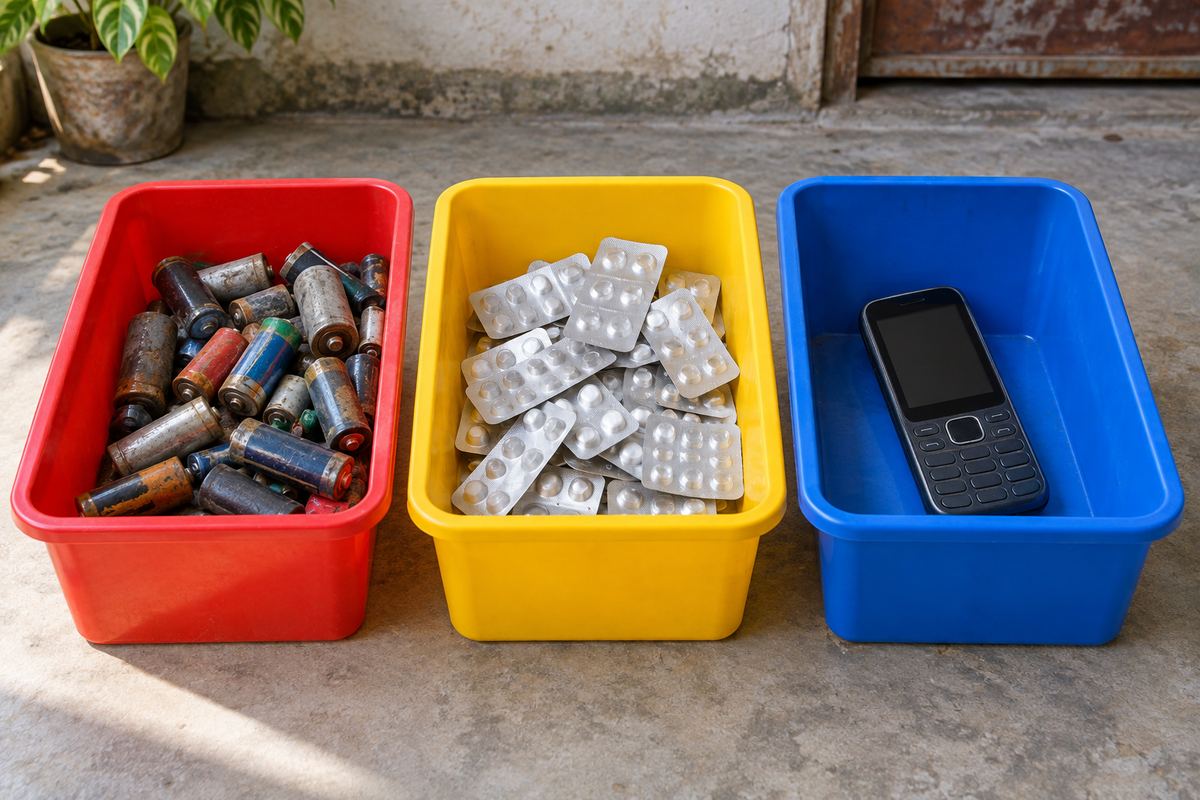
First, learning from the municipality’s or city corporation’s waste section how they will take these things. Then leaflets house by house in one neighbourhood: expired medicines, old batteries, dead phones, chargers and bulbs go not into drains, ponds or fire, and not within children’s reach; keep them in a separate packet. On a set day, collection in three separate boxes, and handover the same day the way the municipality has said.
Why it matters
Old batteries and electronics hold substances that do harm when they seep into soil and water; burned, they give off toxic smoke, and batteries can burst. Thrown-out medicines are a danger in a child’s hands and harm the environment in water. The simplest step is to keep them apart from ordinary waste.
What changes after
At least a hundred homes know what to keep apart; three boxes filled on collection day; a written receipt from the municipality for the handover.
Who can join
Anyone; with someone from the ward councillor’s office, talking to the municipality is easier.
Step by step
0 of 3 steps doneHow to do it, in order.About 6 hours across all steps
- 1
First learn where it goes
Ask the municipal or city corporation waste section, or the ward councillor’s office, how and where they will take these things.
90 min
Not startedIn hand:Nobody yet - 2
Leaflets, house by house
Three points: not in drains or ponds, not in fire, not within children’s reach; keep them in a separate packet. The collection day and place written on it.
150 minলিফলেট
Not startedIn hand:Nobody yet - 3
Collection day and handover
Three separate lidded boxes: medicines, batteries, electronics. Handed over the same day the way the municipality has set, with a written receipt.
120 minঢাকনাওয়ালা বাক্স, গ্লাভস
Not startedIn hand:Nobody yet
What you need
- Leaflets · ২০০টি
- Sturdy lidded boxes · ৩টি
- Gloves · জনপ্রতি ১ জোড়া
When it counts as done
- Leaflets in at least a hundred homes, with a list
- A photo of the three separate boxes and a written receipt for the handover
Proof required
- Photo
- Document
Safety
Do not open, break or burn batteries or devices. Put swollen or leaking batteries in a separate plastic bag. Never give or sell any medicine to anyone.
The full guide
What it takes, and how to do it
Never done this before? No matter. The cost, the timeline, who does what, whom to speak to, the day hour by hour, the risks and ready words to send are all here.
- About
- ৳1,500–3,500
- People
- 5
- Time in all
- 6 hours
- Age
- 14 or older
Best timeAll year; before the monsoon, things are set apart before they reach the drains. Afternoons, when families are home.
PermissionTell the ward councillor or union council; for a collection day, the municipal or city corporation waste section’s agreement and handover arrangement come first.
What it costs
Prices differ by district and season; this is a 2026 estimate. Keep receipts and put them in the proof.
| What | How much | Price |
|---|---|---|
| Printing (leaflets, checklists or instruction sheets)200 leafletsWhere: Photocopy and print shop | 200 leaflets | ৳2–5 |
| Sturdy lidded plastic boxes3Where: Plastic goods shop | 3 | ৳250–500 |
| Gloves5 pairsWhere: Hardware shop | 5 pairs | ৳60–120 |
| Zip-lock bags (for leaking batteries)1 packWhere: Grocery or stationery shop | 1 pack | ৳100–200 |
| Total (about) | ৳1,500–3,500 | |
Getting ready, step by step
14 days before
- Visit the waste section to learn how they will take these things; get it in writing or note the officer’s name.
7 days before
- Print the leaflets: three points, the collection day and place.
- Split the neighbourhood into pairs.
3–5 days before
- Leaflets house by house, with a list of homes reached.
Collection day
- Collect in three boxes, hand over the same day, get a written receipt.
Who does what
Lead1
Deals with the waste section, the handover and the records.
Leaflet pairs2
Give the three points house by house, keep the list.
Collection table2
Wearing gloves, put items in the right box; leaking batteries in separate bags.
Whom to speak to first
The municipal or city corporation waste section
- Why
- They decide where the collected items go.
- How
- Give a written request, keep the received copy; fix the handover day and time beforehand.
The ward councillor or union council member
- Why
- People know them; their office can help spread the word.
- How
- Meet them with a one-page plan.
The local pharmacy
- Why
- People ask about medicines there.
- How
- Ask to leave a leaflet at the counter.
The day, hour by hour
- 15:00Gather, gloves, safety talk (no opening, breaking or burning).
- 15:15Three labelled boxes on the table: medicines, batteries, electronics.
- 15:30Take items in; note only counts, not who gave what.
- 18:00Close the boxes, photograph them, hand over where the municipality set, get a receipt.
How to take the proof
- A photo of the three labelled boxes.
- A list of homes reached (lanes and counts, not names).
- A photo of the written handover receipt.
Common first-time mistakes
- Starting collection with no handover arranged.
- Mixing everything in one sack.
- Selling to a scrap dealer.
What can go wrong, and what to do
A battery heating up or catching fire
Swollen or damaged batteries go in separate bags, in the shade, away from other items; in a fire call 999 or 16163.
Someone wanting the collected medicines
Give them to nobody; keep the box shut and someone beside it at all times.
The municipality cannot take it at the last minute
Seal the boxes and keep them safe, dry and out of children’s reach; ask in writing for a new date.
Ready words to send
Copy, fill the [brackets], send.
WhatsApp / Facebook invitation
Join us to keep old medicines, batteries and dead phones apart! Where: [neighbourhood] When: leaflets on [date]; collection on [date], 3 to 6 pm, at [place] What: three points, house by house: not in drains, not in fire, not within children’s reach. We provide gloves. Age 14 and up. To join: send a join request on this task’s page on Desher Kaj, or tell [lead’s name] in this group.
Letter to the waste section
Date: [date] To [Waste management officer] [municipality / city corporation] Subject: Separate collection and handover of expired medicines, old batteries and e-waste in [neighbourhood]. Sir/Madam, We are asking the residents of [neighbourhood] to keep these items apart from ordinary waste, and wish to hold a collection day on [date]. Please let us know how and where your office will receive them, and we will hand them over that way. No money will be collected from anyone for this work; what is needed comes as gifts in kind or at the team’s own cost. Yours faithfully [Name], team lead [team name], a volunteer team on the Desher Kaj platform Phone: [number]
After it is done
- Hold a collection day every three months, at the same place.
- If the municipality sets up a standing arrangement, spread the word.
Questions people ask
What if the municipality has no arrangement?
Do not hold a collection day. Do only the leaflets (keep them apart, out of children’s reach) and give the municipality a written request, with a received copy.
Can we not sell it to a scrap dealer?
No. In many places wires are burned to recover metal, spreading toxic smoke. Give it only to the arrangement the municipality sets.
Can I join if I cannot stay the whole time?
Yes. Say in your request which step or which hours you can do. The lead will give that step to you.